

Pity the Post
What explains the ongoing spiral at the Washington Post?

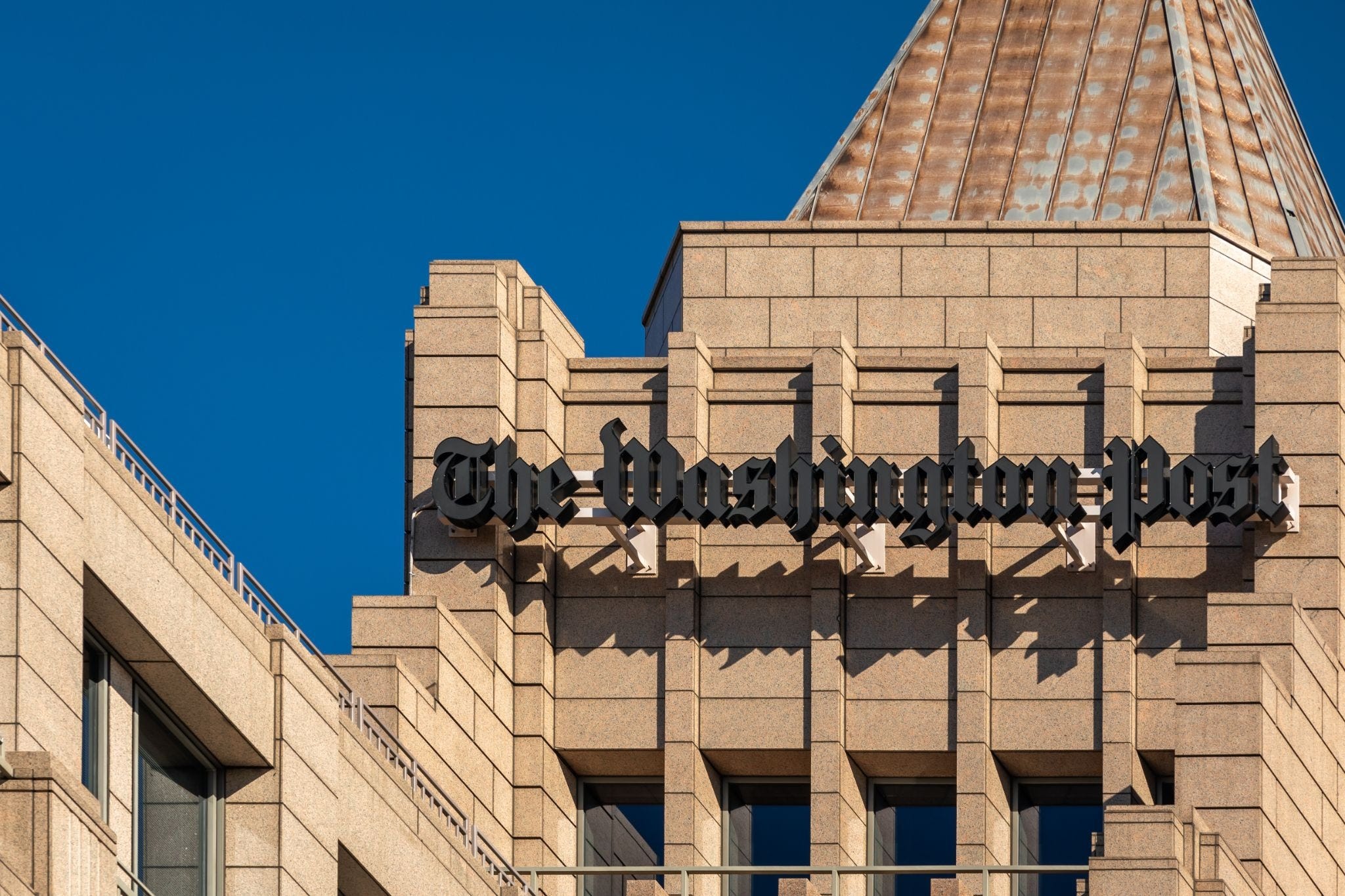
Everyone’s asking: What happened to the Washington Post? How did such a blue-blood paper come unmoored?
A full accounting of the Post’s peril is a much longer one that I’m in no way equipped to tell. For first-hand accounts, I recommend reading interviews with two former Post media critics: Paul Farhi, who spoke to Poynter (link) and Erik Wemple (link), who talked to Business Insider, and check out this long tweet from Katherine Boyle for more context.
While everyone is talking about the news, though, I did want to share some thoughts on the saga tied to media bias, profitability, and the future of the press. In particular, I wanted to try to make sense of the well-obviously-it-isn’t-the-journalists’-faults sentiment that has sprung up around the news.
You probably saw the news. Earlier this month, Washington Post announced that it was laying off about 350, or fully one-third (or perhaps more) of its staff. The Post gutted its Metro coverage of Washington, DC, and the surrounding area, essentially eliminated its (once really excellent) sports desk, and paired back international coverage. Moving forward, the paper will spend more energy and resources focused on national news and politics, Post leadership communicated (some thoughts about the lack of wisdom in this pivot are below).
The direct cause is a familiar one for legacy media outlets. The New York Times reported at the time that Matt Murray, the Post’s executive editor, told staff, “the company had lost too much money for too long and had not been meeting readers’ needs.”
I’ve long shared the latter concern around the Post’s coverage. My local paper has gone all-in on making President Donald Trump the only story in the known universe, at the expense of local issues and more interesting and telling matters of politics. It has taken part in biased and conspiratorial media narratives, from pushing unverified claims around Trump and Russia to calling Republicans conspiracy theorists for the now-supported lab leak theory of COVID origin, to covering for the Biden administration on Hunter Biden’s laptop. Its newsroom has been overtaken by many of the awful trends that make Americans resentful of the press. More recently, the paper has advanced divisive and inaccurate claims on ICE protests in Minnesota. I won’t linger on my other gripes about the Post’s coverage in recent years.


But as the Atlantic’s Derek Thompson pointed out recently on Twitter, media bias doesn’t, by default, spell financial doom for a publication. He’s right about the dissonance generally, but I think the Post is a special case, and that paper’s shift in coverage over the last few years really has played a role in the Post’s fall from grace.
It flows from the audience a publication tries to target. Smaller outlets can chase more niche audiences. Explicitly political ones – think Fox News or MS Now (neé MSNBC) – can recruit readers from the ranks of their partisans. But for the titans of legacy media like the Post, the selling point was always credibility. The Washington Post has hung its hat on being a straight-news, politically unbiased outfit since 1933, when the newly purchased and reconstituted paper declared “the first mission of a newspaper is to tell the truth as nearly as the truth may be ascertained” and “The Newspaper shall tell ALL the truth so far as it can learn it, concerning the important affairs of America and the world.”
The left-leaning bias that has crept in in recent years has eroded some of that augustness that was the Post’s calling card, and I think helps explain why fewer people are willing to pay for it.
That’s of course within a larger story about declining trust in the press. Late last year, Gallup found that only 28% of Americans trust the media – a record low. Earlier this year, Pew Research revealed only 6% of Americans trust journalists to act in the public interest. Readers, listeners, and viewers are tired of what they see as a biased, “mainstream” media, one unwilling to tell hard truths or explore stories and ideas that seem to counter the legacy media’s preferred narrative – which always seems to lean Left.
While these shifts in legacy media aren’t unique to the Post, one detail mentioned in every story about Washington’s seminal paper was that the paper – out of stubbornness or sheer incompetence – refused to evolve. Where the New York Times was finding new angles of coverage, buying entire outlets to shift its offerings, or investing in games and other non-news features, the Post was standing still, as the world was crashing down around it.
Complicating matters further, the Post’s audience in recent years has grown increasingly partisan, as Glenn Kesller, the Post’s former fact checker, admitted to journalist Mark Halperin earlier this year. The paper’s decision (or, perhaps more accurately, the paper’s owner’s decision) to kill its planned endorsement of Democratic Party nominee and former Vice President Kamala Harris ahead of the 2024 Election cast this in sharp relief: 250,000 subscribers – 10% of the paper’s total – canceled their subscriptions, as did a number of reporters, columnists, and even editorial board members (that so many of the Post’s staff would resign in protest when the allegedly nonpartisan paper wouldn’t publicly back the Democratic Party candidate for president might be the subject of a future article). The Post had become too partisan for those who wanted real journalism, and not partisan enough for those counting on liberal comforts.
And onlookers sometimes forget that the Post’s problems didn’t start there. It was actually losing readers in 2022, nearly a decade after Jeff Bezos acquired the paper, as the above forces weighed on it, and as Trump coverage drew fewer clicks and broader structural problems haunted the legacy media. Perhaps the latest changes will stop the slide. Changing anything at this rate is likely better than not doing something,
Stepping back, the self-immolation of a flagship publication shouldn’t be cause for celebration. I can’t stand the grave-dancing when journalists get laid off. And (writing as a DC resident myself) the nation’s capital will be worse for the Post’s downsizing. As I write this, the nation’s capital is experiencing the largest wastewater leak in U.S. history, with hundreds of millions of gallons of raw sewage flowing into area waters. How that happened – and what the consequences of it are – would be a good subject for the local paper of record.
And I find the Post’s new direction — doubling down on politics, where they’ve lost their competitive advantage (I think) to the New York Times, at the expense of a much-needed Metro and sports desk – discouraging. The biggest media takeaway from the end of Trump’s first term is that the sugar high of Trump attention can drive ratings, it isn’t a long-term solution to declining news consumption – as I wrote about at the time in the Washington Free Beacon:
When the Trump presidency ended, so did the media’s ratings fiesta. CNN’s hangover was especially bad, with the network losing half its viewership across certain demographics. The New York Post reported in 2021 that “CNN saw a 34 percent drop—from 1.7 million viewers from Nov. 4 through Jan. 20 to 1.1 million since Biden took office.”
Trying to chase that high again, midway through Trump’s second term, makes clear that the management of Washington Post hasn’t learned much of anything from the last time he left office.
But I think there’s reason for hope. The legacy media needs to change, and I think creative destruction is probably the only force that can do much to facilitate that, because the press has proved it isn’t capable of fixing itself. For more on that, read my piece for the next edition of the Washington Examiner magazine about how I think today’s yellow journalism will end.
I have a longer piece I’m working on for another publication on this subject that I’ll share an excerpt of here soon, tied to the end of yellow journalism at the turn of the 19th century).
The rise of self-publishing platforms like Substack helps increase the diversity of voices that I think the media needs amid that churn. And, just up the road, a Pulitzer-winning outlet, the Baltimore Banner, is seeking to build in the ashes of the Post. I hope they are able to do that well.
Taylor Lorenz had to be one of the reasons. She was just plain embarrassing and I don’t see hos anyone could take WaPo seriously with her narcissistic antics of doxxing, weeping, etc.
The hysterical meltdown the WaPo propagandists had when Bezos yanked the Kamala endorsement tells you all you need to know about them and their grandiose self-regard and enormous sense of entitlement.
First there's the insanely inflated view of their importance, relevance and authority—as if the endorsement would change any votes, considering 1) most people ignore them; and 2) anyone reading the Post editorials was already very likely to be a Harris voter.
And then there's the juvenile aspect: do grown adults and supposed professional journalists need every person, place and thing to reflect their views back to them, with the same words and emotions? And when they don't, they start screaming about fascism and authoritarianism? (For the 10th straight year!) WaPo journalists seem to think of their workplace like a teen thinks of their bedroom—my property! Mom and Dad can't come in, but they better keep paying the bills.
Democracy may die in darkness (or in the brain of a senile president, whose Potemkin Administration somehow WASN'T a threat to Democracy), but journalism dies when the first purpose of the work becomes meeting the political, career, social and emotional needs of the journalist. No one needs any journalist to "save" them or their souls or their countries, and no one needs to learn proper morality or Right Think from a priestly caste who imagines themselves blessed with a "moral clarity" that is nothing more than a cobbling together of progressive dogma with the needs of the news cycle.
Journalism started its suicide when journalists decided they were a secular priesthood and that reporting facts was beneath them, as what they really wanted to be were prophets, moral shepherds and well-compensated hall monitors. It wasn't darkness they needed to worry about, but their sanctimony addiction, which seems impervious to every intervention, even unemployment.